
10 Types of Customer Service for Business Growth


Customer service is an investment you make for your business's future. One positive experience in your customer service can turn a one-time customer into a loyal customer. Feedback during customer service interaction can help identify areas for improvement and drive innovation.
Exceptional customer service can lead to powerful word-of-mouth marketing. In today's business environment, where products & services are easily imitable, customer service can be a differentiating factor for your business. It will help improve sales, increase customer retention, and build brand image. Therefore, companies are focusing on various types of customer service.
To learn more about customer service and strategies to improve it in your business, read our comprehensive guide to customer service excellence.
This blog will help you understand customer service types that you can use in your business or your customer service department.
Customer Service with human involvement
Walk-In Support
Email Support
Telephone Support
Video Customer Support
Live Chat Support
Social Media Support
Customer Service with Technological Involvement
Interactive Voice Response
Chatbots
Self-service customer support
Best of Both: Tech – Human Collaboration
Omnichannel experience
Let us understand each of the customer service support in detail:
1. Walk- In Support
Walk-in support is opted by the customer when they have issues with the product they have already purchased. This support is mainly provided in retail and repair stores, where customer service representatives welcome customers. These issues are solved immediately, or a timeline is given to the customer. The customer service representatives are trained to deal with angry customers and offer a fantastic customer service experience.
Explore more: How to manage angry customers
2. Email Support
Customers prefer email customer service due to its convenience and no cost. This customer service type helps the customer with a systematic process wherein the customer can elaborate on the problem with proof, like images and videos.
Also, the conversation with an agent can be documented and kept as proof while dealing with B2B companies. This type of customer service is suitable when the issue to be solved is not urgent.
3. Telephone Support
If the issue related to the product/ service is to be solved immediately, Telephone support is the preferred customer service for the customers. This helps customer service representatives understand the tone of customers and the urgency related to the issue. This customer service type can be easy for people from older generations and where internet connectivity is unreliable.
The drawback of this customer service type is that the amount of information shared is limited, as the time spent on a call is limited.
4. Video Customer Support
Video customer support provided real-time communication between customer support representatives and customers through video conferencing tools like Zoom, Skype, and Teams. It is a convenient platform for customers, as it is suitable for situations where visual guidance and demonstrations can help customers understand. It is ideal for technical support, product setup, and personalized consultations. The drawback of this type of support is that it requires good internet connectivity.
5. Live Chat Support
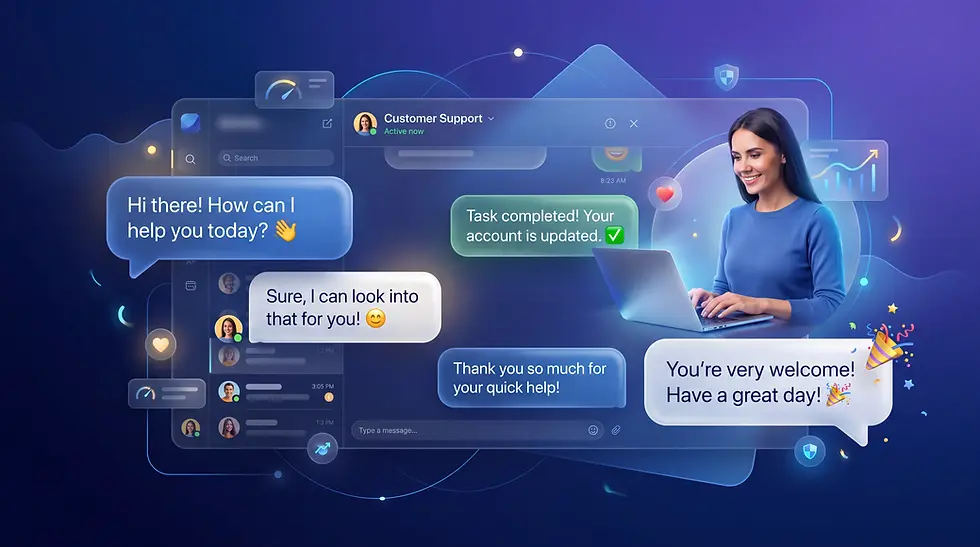
Customers can use live chat support to contact a customer service representative immediately. With this feature, you can get the benefits of both telephone support and email support, wherein you can write multiple questions and get the answers quickly. This also helps customer service representatives answer multiple customers simultaneously, which is much cheaper than a phone call. Customers and customer service representatives can chat and continue their regular tasks simultaneously.
6. Social Media Support
Today, people worldwide use social media platforms like Facebook, Instagram, and Twitter. If they find any issue regarding their purchased products and services, they immediately put reviews of the company or the products on these platforms.
For this, customer service representatives constantly monitor social media platforms, answer their queries, and provide guidance to solve their issues. This type of support can act as a marketing tool where other people can see the company’s commitment to their customers through the interaction between the customer and the representative. This customer service type has many risks, like lack of privacy where sensitive information can be disclosed; this can also hamper the company’s image. It is an ideal platform for engaging your customers and solving general queries.
7. Interactive Voice Response
Interactive Voice Response is an automated support that interacts with customers with the help of a dial pad and voice assistance. It helps customers by asking simple questions without human interference.
The questions can be updated on the system to provide the relevant information to the customer based on what they are looking for. This customer service type helps customers with minor queries and can be used in companies that don’t want to invest a minimum amount in human resources.
The drawback of this issue is that the customers can be redirected to different answers, leading to customer dissatisfaction. Companies planning to adopt this type of customer service must design this function properly.
8. Chatbots
Chatbots are another type of customer support that doesn't require the involvement of a customer service representative. These are programmed in such a way that they simulate human conversation with an end user. These chatbots are found on the company's website or mobile application, where the queries can be answered quickly.
The advantage of this customer support type is that they provide immediate assistance to customers and can answer multiple customers simultaneously, making them cost-effective.
The drawback of the support is that the wait time is longer during peak hours. It also lacks human and personal touch and requires a separate IT team to manage the chatbot.
9. Self-service customer support
The company provides self-service customer support through FAQs or video tutorials mentioned on the company’s website. This helps customers who want to research independently and solve their issues without human assistance. The advantages of Self-service support are that it's available 24/7, is a cost-effective option, and most customers prefer it.
The drawback of this support is that it can lead to customer frustration if it is not regularly updated and well-designed. Also, complex issues cannot be solved with this customer service type.
Self-service support should be used for businesses with a vast customer base who need answers instantly for basic queries. It is suitable for tech companies and online services.
10. Omnichannel Customer support
First, what is Omnichannel customer support?
Suppose you bought things in a physical store, website, or mobile app. Now, you need help with your purchase or need assistance. With omnichannel customer service, you can reach out for help in any of those places, and the company will have all your info and history so they can help you smoothly, no matter where you ask for it.
It's like having a customer service team that's always ready to assist you, whether you're in a store, on a website, or using an app.
In Omnichannel customer support, you can integrate technology and human support so the customer doesn’t have to repeat his issues on different channels. The benefits of the customer service type are that it improves customer loyalty, improves transparency across all channels, provides accurate customer data, and is convenient to customers.
How do you select customer service support for your business?
The following are the factors to consider while selecting customer service support :
1. Type of Industry:
When choosing customer service support for your business, it is essential that you consider the industry in which you work.
For example:
Appliances and gadgets: The most suitable customer service type is walk-in support or Video customer support.
Retail: The preferred customer service types are telephone support, live chat, email support, and FAQs.
OEMs: Email, telephone, and video customer support are usually preferred.
2. Size of customer service department:
The team size is the next important thing to consider; if you have a small customer service department, you can use Chatbots, FAQs, live chat, and video support services for basic queries. Your customer service representative can provide email support for complex issues.
3. Customer base:
Knowing your customers' demographics or potential customers is important. This will help you determine the customer support channels they are comfortable using.
For example, The Younger generation will prefer Self-service support, while the older generation will prefer telephone support.
4. Market Trends:
It is important to keep track of the type of customer service trending in your industry and adopt it in your business to stay caught up with your competitors in your customer service support.
Conclusion
In today's business world, winning customers matters to achieve growth and improve sales; this can be achieved by delivering outstanding customer service. Choosing the proper customer service channels and hiring an exemplary customer service representative can be a powerful differentiator that sets businesses apart from their competitors. By catering to your customers with a mix of customer service types like phone support, live chat, email, chatbots, omnichannel support and self-service options, in minimum time, you'll build trust, solve problems effectively, and keep them coming back in the short and long run. Remember, happy customers are loyal customers, and loyal customers will make your business successful.
Transform Your Customer Service Experience
Improve customer satisfaction and build loyalty with the right customer support strategy.



Comments